Assumed audience: Wealth managers who show clients long-term portfolio projections and want to understand how they are actually made. Anyone who chooses or builds planning tools and wonders whether the assumptions underneath them hold up.
Every long-term portfolio projection is built on a model. The model in use today rest on assumptions about market behavior that were stated in 1900 and haven't been updated since — at least not for this purpose.
Edgelab's latest research builds a more realistic model — one that incorporates what markets actually do over long horizons — and shows how treating a key input as uncertain, rather than fixed, produces more honest results.
1. The simulation on the screen
When a client asks whether they'll retire comfortably in 25 years, you can't give them certainty. But you can show them a range: good markets, most likely, bad markets. That range comes from a simulation. The software runs thousands of imaginary futures — different sequences of returns, different market conditions — and maps out where the portfolio ends up in each one. The spread of those outcomes is what you show the client.
The questions worth asking are: how were those imaginary futures generated? What assumptions did the software make about how markets behave?
Most of the time, those assumptions go unexamined. And just as often, they are wrong in ways that matter.
2. Where the 1900 model is incomplete
Most simulations today are built on a model invented in 1900 by a French mathematician named Louis Bachelier. It treats markets like a coin flip every day. Each flip is independent — yesterday's result tells you nothing about today's. Outcomes follow a bell curve: most days are ordinary, a few are great or terrible, and truly extreme events are vanishingly rare. Volatility stays constant over time.
The model is elegant and easy to work with. It underpins most of the long-term planning tools used in wealth management today.
The problem is that markets don't behave this way.
Markets have two kinds of memory. At short horizons — up to a few months — returns show mild positive correlations. Gains tend to be followed by further gains, as trend-following traders amplify momentum. At longer horizons — a few years out — the pattern reverses: returns show mild negative correlations. A sustained run-up tends to be followed by a cooling off; a crash tends to be followed, slowly and unevenly, by a recovery. Nothing guaranteed — just a statistical lean in each direction at each scale. The standard model treats every day as starting fresh.
Volatility is not constant. Anyone who lived through 2008 or 2020 knows this. Volatility spikes, recedes, then spikes again. The standard model assumes a constant level throughout. When markets enter a rough patch, the model doesn’t recognize that the situation has changed — predicting calm while the storm is building or at his peak.
Crashes are more common than the bell curve allows. The standard model implies that a crash as severe as 2008 should happen roughly once every few thousand years. It has happened twice in the last twenty years — 2008 and the COVID crash of 2020. Under the standard model, both were essentially impossible. Real market returns have "fat tails" — extreme outcomes are rarer than ordinary ones, but nowhere near as rare as the usual bell curve pretends.
Each of these is a known limitation in isolation. The research base on all three is substantial, and each has been widely applied to short-horizon problems — options pricing, daily risk management, portfolio optimization. What the paper actually contributes is assembling them into a single multivariate model that works at the scale of decades, where the interactions between effects play out differently and the calibration challenges are distinct.
3. The drift: the input that drives everything
Once you have a realistic model of how markets move, you need to ask: in which direction, and how fast? That is the role of the expected return for each asset class — what practitioners call the drift.
The drift isn't just one input among many. Because of compounding, it dominates everything at long horizons. A model assuming equities return 5% per year and one assuming 7% produce portfolios that look nearly identical in year two and clearly different by year twenty. The long-term simulations are mainly sensitive to this number.
Here is the problem: nobody knows this number with precision. Think of how a weather forecast handles temperature. A point forecast says "it will be 18°C on Thursday," while a probabilistic forecast says "the temperature will be between 14° and 21°C, most likely around 18°." That uncertainty isn't imprecision, but by acknowledging the range is what makes the forecast trustworthy.
Estimating the true long-run expected return of an asset class from historical data is genuinely hard in the same way. The answer depends enormously on which start and end dates you use. The uncertainty is real and it is large.
The standard approach is to pick one number — from historical averages or from a house view — and treat it as known. This is a point forecast. But the precision is an artifact of the assumption. The projection borrows certainty it doesn’t have.
Edgelab's research handles this uncertainty as a probabilistic forecast. Instead of a single assumed mean return, the drift is treated as uncertain — running the simulation across a range of plausible drift scenarios and letting that uncertainty flow through to the output. The result is a more honest picture of possible outcomes: a range built on a range, reflecting what we actually know rather than what we'd like to believe.
4. Why saving and spending are different
There is an asymmetry at the heart of long-term planning that standard simulations handle poorly.
If you're still in the saving phase — putting money in every month — a bad market early on is painful but recoverable. You have time. The market comes back, and you've been buying at lower prices along the way.
If you're in the spending phase — drawing money out every month to live on — a bad market early in retirement is a fundamentally different problem. You are selling assets at depressed prices to cover living expenses. Those shares are gone. When the market recovers, you own fewer of them. The damage compounds in a way that is hard to undo.
This is called sequence-of-returns risk. It is one of the most important and least-discussed risks in goal-based planning — and one the standard model is structurally unable to measure. Edgelab's model can, because it reproduces what markets actually do during crises: the volatility spikes, the fat-tailed losses, the slow and uneven recovery. The historical record confirms it behaves this way. The standard model, by contrast, will always show the portfolio looking safer than it is — precisely in the scenarios that would hurt most.
5. What a better model changes
A wealth manager using a more realistic simulation can have a meaningfully different conversation with a client.
Take Sofia, 52. She has €8 million invested, plans to retire at 62, and wants €300,000 a year in retirement income adjusted for inflation. She also wants to fund her daughter Clara's education at a top university in the US in six years — tuition, housing, the full cost — which she estimates at €400,000.
Two goals on two different time horizons. The tuition bill is close and can't move; it needs certainty. Retirement is further off and can carry more risk along the way.
This is a fairly standard wealth management situation. It's usually solved with two baskets, each with its own risk profile — the near-term goal held conservatively, the long-term goal allowed to carry more equity, with diversification across fixed income, real estate, commodities, and foreign currency as needed. None of that is new and Advisors know how to build it.
What the model changes is the quality of the answer underneath the plan.
Our simulation produces a better assessment of the terminal wealth Sofia can expect — and, more importantly, of the uncertainty around it. Especially in the lower tail: the risk of not reaching the goal. That is the number that matters, and it is the number the standard model gets wrong, always in the same direction — reporting a portfolio that looks safer than it is, precisely in the scenarios that would hurt Sofia most.
That's a more honest conversation. It's also a more useful one — it prepares the client for a range of outcomes instead of anchoring them to a single number carrying more confidence than the evidence warrants.
The implications extend well beyond private wealth. The same methodology applies wherever long-horizon projections drive real decisions: defined benefit pension funds modeling their ability to meet future liabilities, defined contribution schemes designing default glide paths, insurance companies stress-testing long-duration commitments. The standard model understates the dispersion of outcomes across all of these contexts. The stakes in institutional settings are if anything higher, because the populations exposed to modeling error are larger and have less room to adapt.
The goal of better modeling isn't to make the future look worse. It's to represent it accurately — including the uncertainty — so that the decisions made today are calibrated to what could actually happen, not just to what we'd prefer to assume.
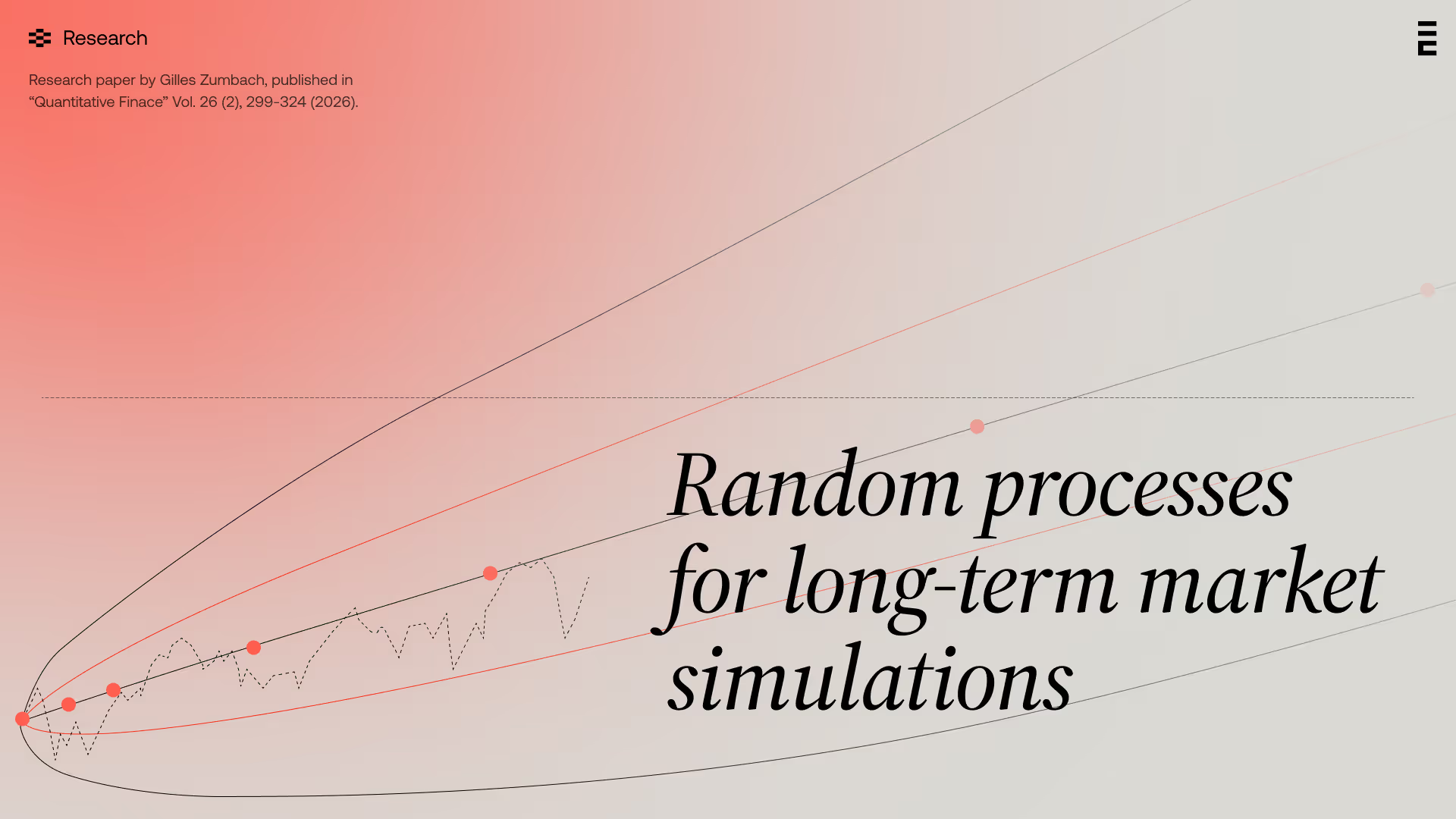
Based on research paper of Gilles Zumbach, "Random processes for long-term market simulations," Quantitative Finance, Vol. 26(2), 299–324 (2026).
{{cta}}
P.S. Curious how risk models get validated day to day — not over decades, but over the short horizon where VaR lives? We have a piece on back-testing methodology and what it takes to genuinely pass and another on stress-testing a full portfolio against real historical crises.
Heading 2
Heading 3
Heading 4
Heading 5
Heading 6
Lorem ipsum dolor sit amet, consectetur adipiscing elit, sed do eiusmod tempor incididunt ut labore et dolore magna aliqua. Ut enim ad minim veniam, quis nostrud exercitation ullamco laboris nisi ut aliquip ex ea commodo consequat. Duis aute irure dolor in reprehenderit in voluptate velit esse cillum dolore eu fugiat nulla pariatur.
Block quote
Ordered list
- Item 1
- Item 2
- Item 3
Unordered list
- Item A
- Item B
- Item C
Bold text
Emphasis
Superscript
Subscript